Understanding How to Protect Your Piano from Colorado’s Ever Changing Climate
A piano is constantly responding to the environment around it. In Colorado, where humidity levels can swing dramatically between dry winters and seasonal storms, those changes can quietly affect everything from tuning stability to tone and touch. It’s important to understand how humidity affects a piano and learn ways to protect its sound, performance, and long-term health
Many people assume a piano goes out of tune because the strings loosen over time. In reality, humidity-related movement inside the piano is usually the largest contributing factor.
Piano’s Wood Components Naturally Respond to Moisture
Among all the wooden parts inside a piano, the soundboard is the most sensitive to humidity fluctuations. The soundboard is the large wooden panel located beneath the strings, typically made from spruce because of its strength and excellent acoustic properties. Rather than being completely flat, the soundboard is built with a slight upward curve known as crown. This crown helps transfer the vibration of the strings into the body of the piano, allowing the instrument to produce its rich, resonant tone.
Like all wood products, piano components naturally absorb and release moisture from the surrounding air. This characteristic is known as hygroscopic behavior, and it affects nearly every wooden object around us. Many people have experienced doors that stick during humid weather and loosen again when the air becomes dry.
Inside a piano, however, these changes matter much more. Because a piano is built with extremely precise tolerances and operates under thousands of pounds of string tension, even microscopic movement in the wood can noticeably affect the instrument’s tuning, touch, and tone.
These movements are usually microscopic, but within a piano they influence everything from tuning stability to touch and tone.
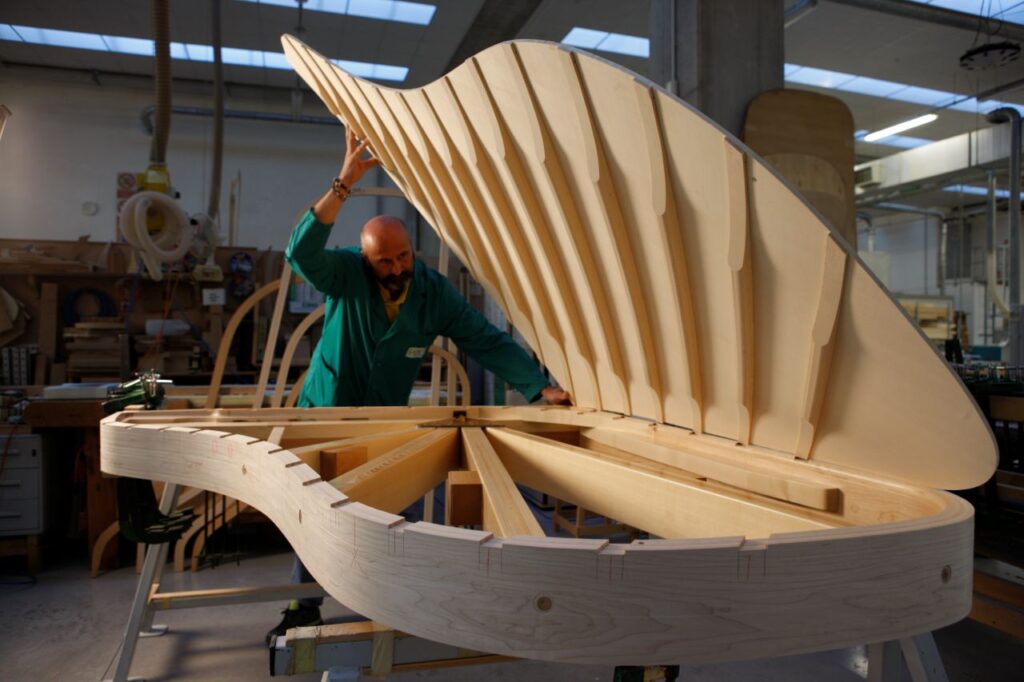
Image credit: Fazioli Pianoforti
As humidity rises, wooden piano parts absorb moisture and expand slightly. In the soundboard, this increases the crown and raises pressure against the strings, often causing the piano’s pitch to drift sharp. During dry conditions, the opposite occurs. The soundboard loses moisture and contracts, reducing crown and lowering string tension, which causes the piano to drift flat.In extreme cases, prolonged dryness can place enough stress on the soundboard to cause cracking.
Because the soundboard amplifies the vibration of the strings, even subtle shape changes can alter how the piano sounds. During humid periods, some pianos may sound brighter or more powerful. During very dry conditions, the tone may become thinner, less resonant, or less responsive.This continuous cycle of expansion and contraction is one of the primary reasons pianos naturally go out of tune throughout the year.
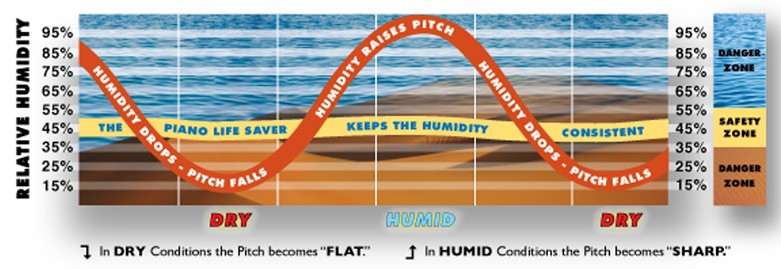
Image reference: Piano Life Saver System humidity illustration
https://www.pianolifesaver.com/how-it-works/#relative
Why Colorado’s Climate Is Especially Challenging
Colorado presents a particularly difficult environment for pianos because of its naturally dry climate and rapid seasonal weather swings.
During winter, indoor heating systems can dramatically reduce humidity levels inside homes. It is not uncommon for indoor relative humidity to fall below 20% during colder months. Many piano owners notice their instrument behaving differently during winter. The piano may drift out of tune more quickly, the touch may feel less consistent, and the tone can become thinner or harsher.
As spring and summer arrive, Colorado weather patterns often shift rapidly. Snowstorms, rain systems, and summer thunderstorms can temporarily increase indoor humidity levels. While these changes may seem minor, repeated humidity fluctuations force the piano to continually expand and contract.
The overall stability of the instrument depends heavily on the condition of the wood.
Over time, this movement contributes to wear throughout the instrument. Tuning stability suffers, action regulation can change, keys may become sluggish or stick, and wooden components experience ongoing stress cycles.For this reason, Colorado piano owners often require more frequent tuning and environmental management than piano owners living in more stable climates. Many instruments benefit from professional tuning at least twice per year, while pianos used for teaching, recording, performance, or serious practice may require even more frequent service.
The Piano Life Saver System (Dampp-Chaser)
One of the most effective ways to manage piano humidity is with the Piano Life Saver System by Dampp-Chaser. The system automatically adds moisture during dry conditions, helping maintain a more stable humidity level around the instrument year-round.
Unlike room humidifiers, which attempt to regulate the humidity of an entire home, the Piano Life Saver System is directly attached to the piano, focusing specifically on the environment surrounding the soundboard and other sensitive wooden components.
Maintaining a stable humidity environment is one of the most effective ways to improve tuning stability and reduce long-term stress on the instrument.
The Piano Life Saver System can be installed in both upright and grand pianos. Most components remain concealed behind or beneath the instrument, while a small visual indicator allows the owner to monitor system operation and maintenance needs.
The system includes:
- humidity sensing components and control box
- humidifier that provides moisture when environment is too dry
- dehumidifier that removes moisture
- water reservoir maintained by the piano owner
- power supply
When humidity levels fall too low, the system automatically activates to add moisture where the piano needs it most.
By reducing seasonal humidity swings, the Piano Life Saver System can significantly improve tuning stability, help protect the soundboard, reduce sticking keys, and preserve the integrity of other wooden piano components. For piano owners living in Colorado’s dry and unpredictable climate, humidity control systems are often one of the best long-term investments they can make in protecting their instrument.
Learn more about the Piano Life Saver System here: Piano Life Saver System Information
Professional Piano Care in Colorado
Hebert Piano Services helps piano owners throughout Colorado’s Front Range — including Fort Collins, Boulder and Denver — better understand how humidity affects their instruments and what can be done to protect them.
With more than twenty years of experience installing and maintaining Dampp-Chaser systems, Hebert Piano Services provides personalized recommendations based on each piano, home environment, and level of use. Dampp-Chaser systems can be installed on nearly any piano in your home.
Maintaining a stable humidity environment is one of the most effective ways to improve tuning stability, reduce long-term stress on the instrument, and preserve the sound and performance of a piano for years to come.
Leave a Reply